I just finished the McKinsey Mind. Overall, I think it was well-written with a smattering of humor. There were a couple unintuitive parts surrounding how to approach difficult clients, but you’re never going to get everything right in the book. This was a pretty straightforward framework, but it didn’t really give me much insight into A. Why McKinsey was good at ideas but bad at implementation and that changed. B. What types of personnel problems and how to relatively assess things like intelligence and interpersonal skills. C. Formulaic approaches to creating logic trees.
Overall, I think this is an A-
Intro
McKinsey is the most prestigious of the consulting firms. Described as somewhat cult-like, with high standards. All McKinsey employees have a similar rigorous training program, and have long nights at the office. Theoretical model:
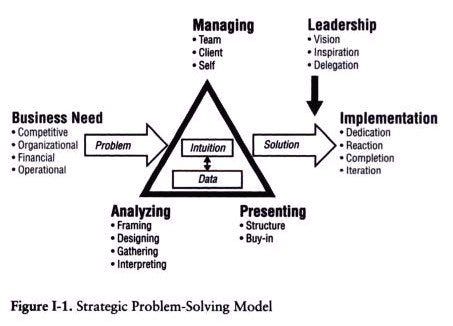
Business Need- You need to have a problem to solve.
Analyzing- Frame the problem in terms of boundaries and constituent elements. Design the things that need to be done to test initial hypothesis. Test the results and develop a course of action
Presenting- Structure your presentation so it communicates ideas concisely and creates buy-in
Managing- Solving problems requires problem-solving team to work, client needs to be kept in loop, and team must not burn out, but also meet expectations
Implementation- Firm dedicates enough resources to focus on completion of tasks- may also require iterations (seems LEAN-ee)
Leadership- Strategic vision must provide inspiration and delegate authority correctly to continue.
Intrinsic tension btw intuition and data. You will not have all relevant facts, but still need to act.
Framing the Problem
Hypothesis speeds up quest for solution by sketching out a road map for research and analyses that guide your work.
Problem-solving begins with structuring problems. One key way to apply structure is Mutually Exclusive, Collectively Exhaustive. Or, in English, problem = exhaustive collection of non-overlapping issues
Structure is good because without it, your ideas won’t stand up. This can strengthen your thinking. Conversely, without it, your ideas won’t stand up. Without internal coherence or logic to solving problems, you won’t solve them. Decision or issue trees can be helpful, with yes/no questions.
Lot of efficiency is gained by not going down wrong paths. Seeing relevant factors allows disregard of unimportant factors.
Start with a big group, break down into constituent logic tree. Solve problem at first meeting, if possible. Try, if possible, to analyze in the context of proving a hypothesis right or wrong, rather than in a vacuum. This helps you disregard important factors.
Prior to the meeting, know the relevant information. In the white room, everyone can speak their mind. Get down ideas on paper. Oftentimes what client asks for is not what the core problem is. Hypothesis allows you to make decision making more effective because you can assess multiple options quickly.
Hypothesis initially relies on intuition. Basic brainstorming approach is Quick and Dirty Test (QDT). Which assumptions do you rely on for hypotheses to be true. If any are false, hypothesis is incorrect.
To make a good tree, you should start with top-line issues that need to be true for hypothesis to be true.
Designing the Analysis
Find the key drivers, or factors that most affect problems. Find the core of the problems. Look at the big picture
General principles: Hypothesis determines analysis, understand priorities, ignore absolute precision, and triangulate tough challenges
Start with the end in mind and work backwards, it’s ok to be directionally correct, meaning to pick low hanging fruit.
Think of direction + order of magnitude when considering solutions- building a factory will provide $$ net profit
When having an abstract problem, look for parallels, or analogies to justify solutions
Some important elements for each issue and subissue: Initial Hypothesis, Analysis to disprove or prove hyopthesis, data to perform analysis, sources of data, brief description of likely end product, person, and due date.
Some analysis can undermine need for other analysis. If A isn’t a solution, questions to support A no longer necessary.
Gathering the Data
McKinsey research principles: Facts are good at bridging gaps, probe those with no idea.
Start with annual report, look for outliers, and best practices.
Relying on facts increases impact of analyses and recommendations. McKinsey also has good data gathering sources. McKinsey employs info specialists. Try to have 3 facts for each point.
Before interviewing, be prepared to write an interview guide- or written questions you’d like to ask. Ask “Is there anything I forgot to ask?”
Active listen. Nod, interjections, uh-huh, uh-huh’. Use positive body language. Politely keep interviewee on focus.
Some strategies for effective interviews. 1. Have boss set up the meeting, 2. Interview in pairs, 3. Listen, don’t lead. 4. Paraphrase, paraphrase, paraphrase, 5. Use the indirect approach, 6. Don’t ask for too much, 7. Adopt the Columbo tactic (on the way out ask a zinger).
As an interviewer, don’t squeeze interviewee dry. Explain the benefit of this information.
There are challenging interviews. Hardballs have their own ideas about how to do things, sandbaggers avoid giving key information, Job-insecure are people who might get eliminated as a result of finding the info.
Always write a thank you note, this can yield future benefits. Structure interviews. Start with an ice breaker before moving onto difficult subjects.
Don’t reinvent the wheel. If someone else knows what to do, use the information.
Control the quality of your input. You need accurate and timely data availability.
Interpreting The Results
80/20 rule is true. 80% of effect under study will be generated by 20 percent of examples analyzed.
Make a chart every day. This will push your thinking to be better, and will help you keep info.
Don’t make facts fit solution. Solution should fit facts. Some interpretation stuff: What is the so what? (is the stuff relevant) Perform sanity checks (is this plausible), limits exist to analysis.
Thought processes need to be documented, otherwise it’s hard to bring others along for the ride
Medium and message are not the same thing. Make sure the solution fits your client. Tailor your solution to a business’s strengths and capabilities.
Presenting Your Ideas
Take audience down path of logic in clear, easy to follow steps.
You should be able to explain the subject of what you’re doing in a 30 second elevator ride.
One message per chart. Have graphics. Put together exhibits for your logic tree.
Start with your conclusion. Don’t start out detailed, because you can always get more detailed, but not less detailed
Important to prewire and tailor your presentations. Prewiring is giving the info prior to the presentation. Tailoring is making it appropriate for the right people.
Prewiring also helps you build consensus, and adapt your solution to the political realities of the organization
Avoid surprising people, surprises being info that forces decision makers to change perspective.
Translate your presentation into relevant corporate lingo.
Managing Your Team
Get the mix right- weigh raw intellect, experience, and interpersonal skills. Meet all team members before you make a decision.
Consider not just demonstrated ability, but potential ability, appreciate diversity, and apply structure to recruiting efforts. Important to hire people who can think logically
It’s not just what you say, it’s how you say it.
Overcommunication is better than undercommunication
Stay in touch with your team and their general attitude.
A little team bonding goes a long way. Be strategic and include significant others
Regarding development, set high expectations, evaluate regularly, and make it balanced. Open feedback is good
Managing Your Client
Pull rather than push demand means building up your reputation first.
Deal with bad team members in a direct, developmental manner- avoid the total misfits.
Two ways to be successful at implementations: share and then transfer responsibility, make the client a hero.
Managing Yourself
Find a mentor you like independently.
Getting on base is more important than winning.
Make your boss look good.
In hierarchies, assert yourself. Be sensitive to other’s authrity, and be ready to retreat.
Good assistant is a godsend.
Respect your time, Make sure you are being sane, and share work
 Isadore Johnson's Website