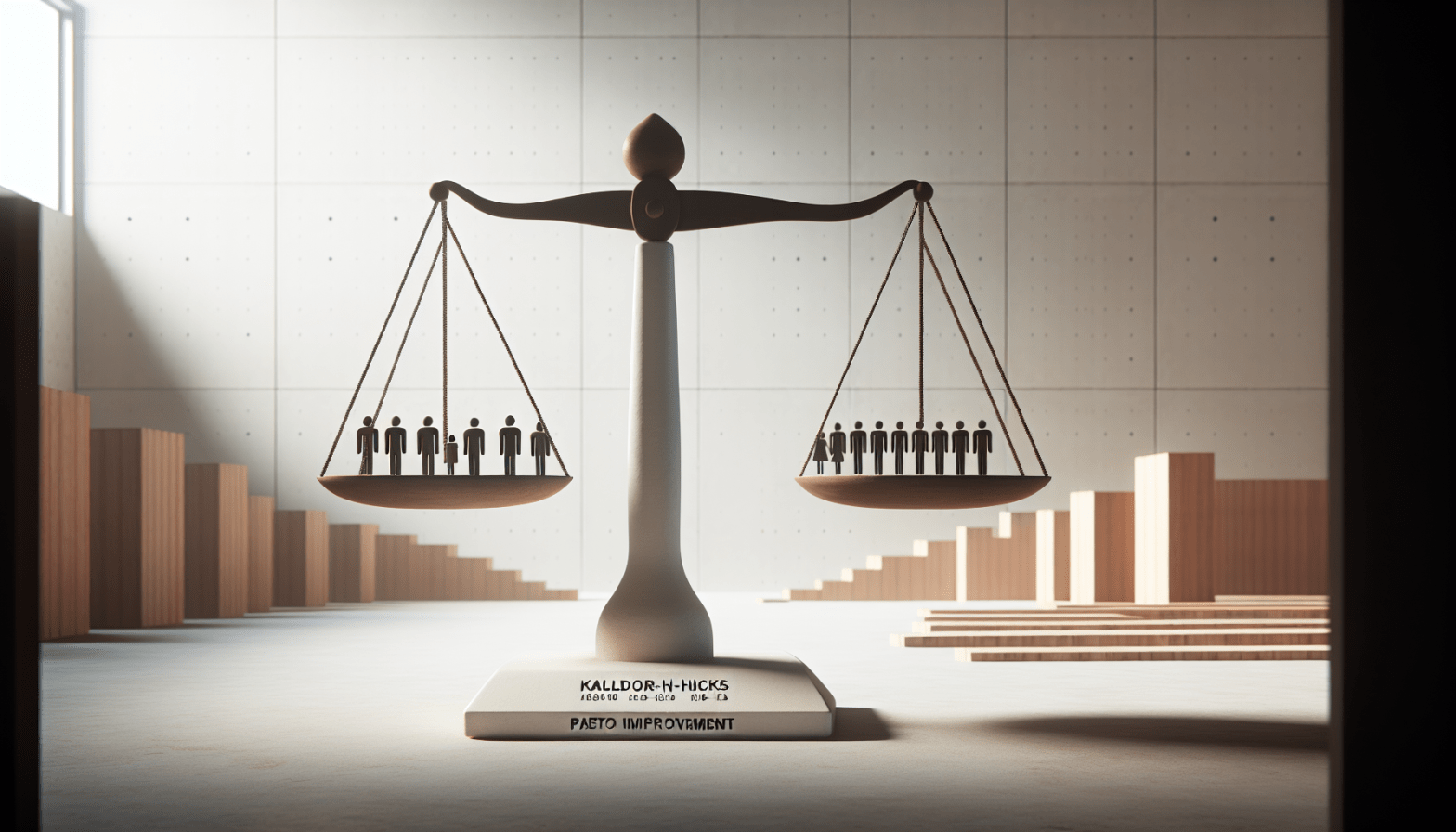
Wikipedia explains that the Kaldor-Hicks improvement criteria is essentially a less stringent version of a Pareto improvement, something where in practice, everyone is made better off. In the Kaldor-Hicks view, merely the ability of the winners to compensate the losers is grounds for claiming something is optimal, regardless of whether such compensation occurs.
The basic premise of a Pareto improvement by contrast is that everyone starts off at least as well as they begun, and some people benefit. As many point out, the conditions where this happens are few and far between. Even something as innocuous as pecuniary or market competition in theory could leave people worse off, because durable profits are less likely in a competitive environment. Taking an approach where harms are magnified, of course it makes sense that we shouldn’t hold up Pareto as the gold standard, because of its unworkability.
Thus, we ought to fall to a less stringent view of optimality to really make public policy. The biggest advantage as well as disadvantage of KH is as follows. Essentially, it’s just cost-benefit-analysis all the way down. Once you remove distributional requirements, total welfare is all that’s left. Since it doesn’t matter how the welfare is distributed, this view of optimality bypasses questions of who should win in situations. Since there is no longer a status quo bias, when a public policy nerd crunches numbers, as long as the net outcome is positive, everything is golden.
This is very good in circumstances where things like cost-benefit analysis aren’t even done regarding public policy. When Cass Sunstein wants to make sure that agencies have some way of numerically justifying what they’re doing, I agree that this in principle makes the institution more measurable and straightforward.
Where I’m skeptical largely comes from credibility. Most people are not numerate, and proponents of a given policy tend to find ways to make most apparent the positives and downplay the negatives. Given that there are fewer variables to manipulate, it’s easier to push through public policy that isn’t justified on the merits. Devolving to KH makes it easier for whatever newfangled idea to be implemented, whereas Pareto puts a more cautionary lens on what gov should do.
Regarding status quo bias, on one hand, I love counterfactuals. On the other hand, thought experiments can be set up in ways to predetermine outcomes, and there are plenty of smart people in government who can push through things you’d otherwise not want to see.
This is why I think Pareto should remain the primary goal of public policy, but I think that KH can be useful.
 Isadore Johnson's Website